
Jewelry is a general word for decorative items worn on the body, such as rings, necklaces, bracelets, earrings, brooches, and other ornamental pieces. People often search for alternatives to jewelry when they want more precise, elegant, formal, or descriptive wording.
The best alternative depends on what you mean. Words such as jewellery, adornment, ornaments, accessories, gems, precious pieces, and fine jewelry overlap with jewelry but are not always exact replacements.
A product description may need polished language, while an academic or historical text may call for terms such as ornamentation or personal adornment. This guide explains the differences so you can choose naturally and accurately.
Quick Answer
The closest alternatives to jewelry include jewellery, adornments, ornaments, accessories, precious pieces, fine jewelry, gems, and personal adornments. However, these terms are not always interchangeable. Accessories is broader, gems usually refers to gemstones, and ornaments emphasizes decoration. Choose the alternative based on meaning, audience, and tone.
Quick List: Alternatives to Jewelry
Here are useful alternatives, grouped by meaning and tone:
Closest Alternatives
- Jewellery
- Adornments
- Ornaments
- Personal adornments
- Precious pieces
- Decorative pieces
- Jewelry pieces
Formal or Elegant Alternatives
- Fine jewelry
- Fine adornments
- Precious ornaments
- Personal ornamentation
- Ornamental pieces
- Precious articles
- Luxury jewelry
Neutral Alternatives
- Accessories
- Jewelry pieces
- Decorative accessories
- Wearable ornaments
- Personal accessories
Contextual Alternatives

- Gems
- Gemstones
- Precious stones
- Heirlooms
- Keepsakes
- Trinkets
- Baubles
- Trophies
Casual Alternatives
- Bling
- Sparkles
- Jewels
- Baubles
- Fancy pieces
Not every word above means exactly the same thing. The distinctions become important in professional writing, product descriptions, and formal communication.
Formal Alternatives to Jewelry
1. Adornments
Meaning: Decorative objects worn to enhance someone’s appearance.
Explanation: Adornments is a close, formal alternative to jewelry, especially when discussing decorative items generally.
Example: The collection includes traditional gold adornments.
Best Use: Fashion writing, cultural descriptions, historical writing, and elegant product copy.
Worst Use: Very casual conversation, where jewelry sounds more natural.
Tone: Formal and refined.
2. Personal Adornments
Meaning: Decorative items worn on the body.
Explanation: This phrase clearly describes jewelry as part of personal decoration. It is broader than jewelry because it can potentially include non-jewelry decorative items.
Example: The museum displays personal adornments from several centuries.
Best Use: Academic, historical, museum, and cultural writing.
Worst Use: Casual shopping conversations.
Tone: Formal and descriptive.
3. Ornaments
Meaning: Objects used for decoration.
Explanation: Ornaments can refer to jewelry, but the word is much broader. It can also describe decorative objects used in homes, celebrations, or other settings.
Example: The exhibition features ornate gold ornaments.
Best Use: Historical and artistic contexts.
Worst Use: When you specifically mean all wearable jewelry.
Tone: Formal to neutral.
4. Personal Ornamentation
Meaning: The practice or appearance of decorating oneself with ornamental items.
Explanation: This is more abstract than jewelry. It focuses on the decorative practice rather than the objects themselves.
Example: Personal ornamentation played an important role in the culture.
Best Use: Anthropology, history, cultural studies, and academic writing.
Worst Use: Product listings or everyday speech.
Tone: Academic and formal.
5. Fine Jewelry
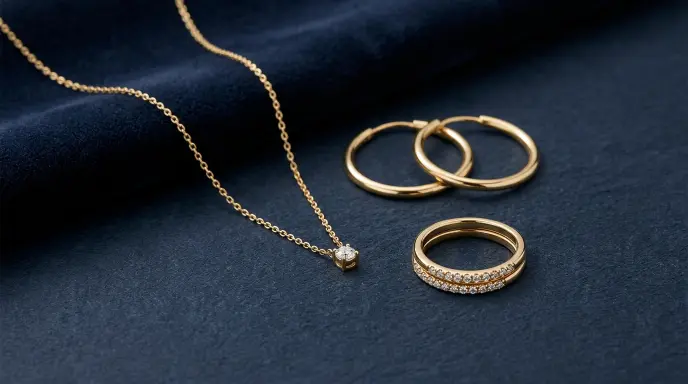
Meaning: High-quality jewelry, often made with precious metals or gemstones.
Explanation: Fine jewelry is narrower than jewelry. It normally suggests quality, craftsmanship, precious materials, or luxury.
Example: The boutique specializes in fine jewelry made with gold and diamonds.
Best Use: Luxury retail, product descriptions, fashion writing, and advertising.
Worst Use: When discussing inexpensive costume jewelry.
Tone: Professional and luxurious.
6. Precious Ornaments
Meaning: Valuable decorative objects, often made from precious materials.
Explanation: This phrase emphasizes value and decoration rather than simply identifying an item as jewelry.
Example: The royal collection contains several precious ornaments.
Best Use: Historical, museum, luxury, and literary contexts.
Worst Use: Everyday retail communication.
Tone: Formal and elegant.
7. Ornamental Pieces
Meaning: Decorative items worn or displayed for visual appeal.
Explanation: This phrase can refer to jewelry, but it may also describe decorative objects that are not worn.
Example: The designer created several ornamental pieces for the collection.
Best Use: Fashion and design writing.
Worst Use: When absolute clarity about jewelry is required.
Tone: Professional and artistic.
8. Precious Pieces
Meaning: Valuable or cherished jewelry and decorative items.
Explanation: Precious pieces is an elegant expression often used when discussing valuable jewelry.
Example: She stored her most precious pieces in a secure case.
Best Use: Luxury retail, fashion, personal writing, and product descriptions.
Worst Use: Technical writing where precise terminology is necessary.
Tone: Elegant and polished.
9. Jewelry Articles
Meaning: Individual items or products made as jewelry.
Explanation: This expression is more product-focused than jewelry itself.
Example: The catalog contains hundreds of jewelry articles.
Best Use: Catalogs, inventory documents, and formal product descriptions.
Worst Use: Everyday conversation.
Tone: Formal and commercial.
10. Luxury Jewelry
Meaning: High-end jewelry associated with premium materials, craftsmanship, or prestige.
Explanation: This is not a complete synonym for jewelry because it describes a specific category of jewelry.
Example: The brand is known for luxury jewelry and custom designs.
Best Use: Luxury fashion, retail, and marketing.
Worst Use: General discussions where inexpensive jewelry is included.
Tone: Premium and commercial.
Semi-Formal & Neutral Alternatives
11. Jewelry Pieces
Meaning: Individual items of jewelry.
Explanation: This phrase is useful when discussing separate rings, bracelets, necklaces, or other items.
Example: The collection contains twelve handmade jewelry pieces.
Best Use: Retail, blogs, catalogs, and everyday writing.
Worst Use: When discussing jewelry as a general cultural concept.
Tone: Neutral.
12. Accessories
Meaning: Items added to an outfit or appearance.
Explanation: Accessories is broader than jewelry. It may include watches, bags, scarves, belts, hats, and other fashion items.
Example: Gold accessories can add a polished touch to a formal outfit.
Best Use: Fashion and lifestyle writing.
Worst Use: When you need to refer only to jewelry.
Tone: Neutral and modern.
13. Decorative Accessories
Meaning: Accessories primarily used for visual decoration.
Explanation: This phrase can include jewelry but does not necessarily mean jewelry.
Example: The designer paired the dress with decorative accessories.
Best Use: Fashion descriptions.
Worst Use: Technical descriptions of jewelry products.
Tone: Neutral and professional.
14. Wearable Ornaments
Meaning: Decorative objects designed to be worn.
Explanation: This is a descriptive phrase that can accurately include many types of jewelry.
Example: The exhibit features wearable ornaments from ancient cultures.
Best Use: Museums, history, fashion, and cultural writing.
Worst Use: Casual speech.
Tone: Formal and descriptive.
15. Decorative Pieces
Meaning: Items valued partly or mainly for their appearance.
Explanation: This phrase is broader than jewelry and may include objects that are not worn.
Example: The designer creates decorative pieces using recycled materials.
Best Use: Design and fashion contexts.
Worst Use: When you need to specify jewelry.
Tone: Neutral.
16. Personal Accessories
Meaning: Items worn or carried to complement someone’s appearance.
Explanation: Jewelry is one type of personal accessory, but the category is much wider.
Example: The store sells clothing and personal accessories.
Best Use: Retail and fashion writing.
Worst Use: When discussing gemstones or jewelry craftsmanship specifically.
Tone: Professional and neutral.
17. Gems
Meaning: Precious or semiprecious stones, or sometimes valuable jewelry in a broader figurative sense.
Explanation: Gems usually refers to gemstones rather than complete jewelry items.
Example: The necklace features several colorful gems.
Best Use: Jewelry descriptions when gemstones are the focus.
Worst Use: When you mean earrings, chains, bracelets, and other jewelry generally.
Tone: Neutral to elegant.
18. Gemstones
Meaning: Natural or synthetic stones used for jewelry and decoration.
Explanation: This is narrower than jewelry. A gemstone can be part of jewelry but is not itself necessarily a finished jewelry item.
Example: The ring contains two rare gemstones.
Best Use: Jewelry, geology, retail, and educational writing.
Worst Use: As a direct replacement for jewelry.
Tone: Technical and neutral.
19. Precious Stones
Meaning: Valuable gemstones, traditionally including diamonds, rubies, sapphires, and emeralds.
Explanation: This refers to stones rather than complete jewelry pieces.
Example: The necklace was decorated with precious stones.
Best Use: Jewelry descriptions and historical writing.
Worst Use: When referring to metal jewelry without gemstones.
Tone: Formal and traditional.
20. Heirlooms
Meaning: Valuable or meaningful objects passed down through a family.
Explanation: An heirloom may be jewelry, but not all jewelry is an heirloom.
Example: Her grandmother’s necklace is a treasured family heirloom.
Best Use: Family history and personal storytelling.
Worst Use: General product descriptions.
Tone: Warm and sentimental.
Informal and Casual Alternatives
21. Bling
Meaning: Flashy or attention-grabbing jewelry, often associated with a bold or luxurious appearance.
Example: He added some bling to his outfit for the party.
When Natural: Casual conversations, fashion discussions, and social media.
When to Avoid: Academic writing, formal business communication, and professional product documentation.
Tone: Very casual and playful.
22. Baubles
Meaning: Small decorative objects, including inexpensive or ornamental jewelry.
Example: She loves colorful baubles and vintage accessories.
When Natural: Informal and descriptive writing.
When to Avoid: Luxury jewelry descriptions where the word may make the products sound inexpensive.
Tone: Casual and sometimes playful.
23. Jewels
Meaning: Valuable gemstones or pieces of jewelry.
Example: The display case contained several beautiful jewels.
When Natural: Literary, elegant, historical, and casual contexts.
When to Avoid: Highly technical descriptions where the exact item or gemstone should be named.
Tone: Elegant or slightly literary.
24. Trinkets
Meaning: Small decorative objects, often inexpensive.
Example: The market sells handmade trinkets and small accessories.
When Natural: Casual descriptions of small decorative items.
When to Avoid: Describing expensive fine jewelry.
Tone: Casual and sometimes dismissive.
25. Sparkles
Meaning: A casual expression for shiny or glittering decorative items.
Example: She added a few sparkles to her outfit.
When Natural: Friendly conversations, social media, and playful writing.
When to Avoid: Formal or professional contexts.
Tone: Playful and informal.
True Synonyms vs. Contextual Alternatives
Not every alternative to jewelry has the same meaning.
| Type | What It Means | Can It Replace the Original? |
|---|---|---|
| True synonym | Has nearly the same meaning in the relevant context | Sometimes |
| Near synonym | Shares much of the meaning but has differences | Often, depending on context |
| Contextual alternative | Works only in particular situations | No, not generally |
| Broader expression | Covers jewelry plus other things | Only when broader meaning is intended |
| Narrower expression | Refers to one category of jewelry | No, unless that specific category is intended |
For example, jewellery is essentially the same word as jewelry in British English. Accessories, however, is broader because it includes many non-jewelry fashion items. Gemstones is narrower because it refers specifically to stones rather than finished jewelry.
Industry-Specific Usage
Business Writing
Business writing benefits from precise terms such as jewelry pieces, fine jewelry, jewelry products, and personal accessories.
Example:
The company introduced a new collection of fine jewelry for the holiday season.
For general inventory, jewelry products is clearer than a decorative phrase such as precious ornaments.
Corporate Communication
Corporate announcements should use straightforward terminology.
Example:
The company expanded its jewelry collection with new gold and silver pieces.
Avoid overly poetic terms if the purpose is to communicate product information clearly.
Academic Writing
Academic writing often benefits from terms such as personal adornment, ornamentation, wearable ornaments, and decorative objects.
Example:
Personal adornment has played a significant role in many historical cultures.
Here, personal adornment may be more appropriate than jewelry because the discussion can include objects beyond modern jewelry.
Customer Service
Customer service language should be clear and specific.
Instead of:
We received your precious ornaments.
Use:
We received your jewelry pieces.
If a customer is asking about a specific product, identify it directly:
Your gold necklace has been received and is being inspected.
Legal Writing
Legal and contractual writing should avoid vague substitutes when a precise product definition is required.
For example, a contract may need to distinguish between:
- jewelry
- precious stones
- watches
- accessories
- personal property
Terms such as bling, sparkles, or baubles are generally inappropriate for formal legal documents.
Email Communication
Professional emails usually work best with simple terms such as jewelry, jewelry pieces, fine jewelry, or accessories.
Example:
We have added the new jewelry pieces to the online catalog.
Clarity is usually more valuable than an elaborate synonym.
Email Examples
1. Client Product Update
Subject: New Jewelry Collection
Hello Sarah,
We have added several new jewelry pieces to the collection, including gold necklaces, silver bracelets, and gemstone rings.
Please let us know if you would like detailed product information.
Best,
Emma
2. Vendor Communication
Subject: Jewelry Order Confirmation
Hello Daniel,
Thank you for confirming the order. We have reviewed the list of jewelry products and everything matches the requested specifications.
Please send the shipping details when available.
Best,
Michael
3. Customer Service
Subject: Update on Your Jewelry Repair
Hello Maria,
Your jewelry piece has been received and is currently being inspected by our repair team. We will contact you once the assessment is complete.
Thank you for your patience.
Kind regards,
Customer Support
4. Academic Communication
Subject: Question About Personal Adornment
Dear Professor Lee,
I am preparing my assignment on personal adornment in ancient cultures. Could you recommend any additional sources that discuss the cultural role of wearable ornaments?
Thank you,
Alex
5. Internal Workplace Email
Subject: Product Description Updates
Hi Team,
Please review the descriptions for the new fine jewelry collection before they are published.
Pay particular attention to gemstone names, materials, and product measurements.
Thanks,
Nina
Short Dialogue Examples
Workplace
Person A: How should we describe these products?
Person B: Use “fine jewelry” because the collection includes precious metals and gemstones.
Classroom
Person A: Is jewelry the same as personal adornment?
Person B: Not exactly. Personal adornment is broader and can include other decorative items.
Customer Service
Person A: Can I track my jewelry order?
Person B: Yes. I can check the status of your jewelry piece using your order number.
Casual Conversation
Person A: I love your new necklace!
Person B: Thanks! I bought some new jewelry last weekend.
Professional Discussion
Person A: Should we call these accessories?
Person B: We can, but “jewelry pieces” is more precise for this collection.
How to Replace “Jewelry” in a Sentence
1. General Use
Original: She bought some new jewelry.
Alternative: She bought some new accessories.
Why it works: Accessories works when the purchase may include fashion items beyond jewelry.
2. Luxury Context
Original: The store sells jewelry.
Alternative: The store sells fine jewelry.
Why it works: Fine jewelry emphasizes quality and premium materials.
3. Historical Context
Original: The museum displayed ancient jewelry.
Alternative: The museum displayed ancient personal adornments.
Why it works: Personal adornments fits historical and cultural discussion.
4. Gemstone Focus
Original: The jewelry contains rare stones.
Alternative: The piece contains rare gemstones.
Why it works: Gemstones is more precise when the stones themselves are the focus.
5. Individual Items
Original: She organized her jewelry.
Alternative: She organized her jewelry pieces.
Why it works: The phrase emphasizes individual items.
6. Family Context
Original: She kept her grandmother’s jewelry.
Alternative: She kept her grandmother’s heirlooms.
Why it works: Heirlooms emphasizes family history and inherited value. It does not necessarily mean jewelry.
7. Cultural Context
Original: Jewelry was important to the community.
Alternative: Personal ornamentation was important to the community.
Why it works: The alternative focuses on the practice of decorating the body.
8. Casual Context
Original: She wore a lot of jewelry.
Alternative: She wore a lot of bling.
Why it works: Bling creates a much more casual and flashy tone.
Comparison Table
| Phrase | Tone | Meaning / Scope | Best Use | Example |
|---|---|---|---|---|
| Jewelry | Neutral | Wearable decorative items | General writing | She bought new jewelry. |
| Jewellery | Neutral | Same meaning as jewelry | British English | The shop sells jewellery. |
| Adornments | Formal | Decorative items worn or used | Cultural writing | Traditional adornments were displayed. |
| Personal adornments | Formal | Decorative items worn on the body | History | Personal adornments reflected status. |
| Fine jewelry | Professional | High-quality jewelry | Luxury retail | The store sells fine jewelry. |
| Ornaments | Formal | Decorative objects | Historical/artistic writing | Gold ornaments were displayed. |
| Accessories | Neutral | Jewelry and other fashion items | Fashion | She chose matching accessories. |
| Gems | Elegant | Gemstones or valuable jewelry | Jewelry descriptions | The necklace contains colorful gems. |
| Gemstones | Technical | Stones used in jewelry | Education/retail | The ring contains gemstones. |
| Heirlooms | Sentimental | Family objects passed down | Personal writing | The necklace is a family heirloom. |
| Trinkets | Casual | Small decorative items | Informal writing | The store sells small trinkets. |
| Bling | Very casual | Flashy jewelry | Casual speech | He loves wearing bling. |
Which Alternative Should You Choose?
- For formal writing: Use adornments, personal adornments, or ornamentation when the broader cultural meaning fits.
- For business communication: Use jewelry, jewelry pieces, or fine jewelry.
- For academic writing: Consider personal adornment or ornamentation when discussing cultural or historical practices.
- For legal writing: Prefer precise terms such as jewelry, precious stones, or specifically defined categories.
- For professional emails: Jewelry pieces or simply jewelry is usually clearest.
- For everyday conversation: Jewelry, jewels, or accessories may work depending on the meaning.
- For casual messages: Bling or baubles can work when the playful tone is intentional.
Grammar & Usage Guide
Jewelry vs. Jewellery
Jewelry is the standard spelling in American English.
Jewellery is the standard spelling in British English and several other varieties of English.
Examples:
- American English: She sells handmade jewelry.
- British English: She sells handmade jewellery.
Is Jewelry Singular or Plural?
In American English, jewelry is generally an uncountable noun.
Natural:
She bought some jewelry.
Natural:
She owns a lot of jewelry.
When talking about individual items, use:
three pieces of jewelry
or:
three jewelry pieces
Avoid treating jewelry as a regular plural noun in standard American English.
Jewelry Piece
When you need to count individual items, piece of jewelry is especially natural.
Example:
The collection includes 25 pieces of jewelry.
Jewelry vs. Jewel
These words are not interchangeable.
Jewelry refers to decorative items collectively.
Jewel can refer to a valuable gemstone or, in some contexts, a valuable piece of jewelry.
Example:
She wore several pieces of jewelry.
The crown contained a rare jewel.
Jewelry vs. Gemstone
A gemstone is a stone that may be used in jewelry. A finished necklace, ring, or bracelet is jewelry.
Example:
The ring is jewelry.
The diamond is a gemstone.
Capitalization
The word jewelry is normally lowercase unless it begins a sentence or appears in a proper name.
Correct:
She designs jewelry.
Not normally:
She designs Jewelry.
Common Mistakes to Avoid
1. Treating Every Alternative as an Exact Synonym
Accessories, gems, and heirlooms do not have exactly the same meaning as jewelry.
2. Using “Gems” for All Jewelry
A necklace can contain gems, but the necklace itself is jewelry.
3. Calling Every Jewelry Item an Heirloom
An heirloom has a family or historical connection. A newly purchased ring is not automatically an heirloom.
4. Using “Bling” in Formal Writing
Bling is strongly casual and can sound inappropriate in professional documents.
5. Using “Fine Jewelry” for Cheap Costume Jewelry
The word fine suggests a higher-quality category, so it should not be used casually for every type of jewelry.
6. Confusing Jewelry With Accessories
Accessories include jewelry but can also include bags, scarves, belts, watches, and other items.
7. Overusing Poetic Terms
Words such as precious ornaments may sound elegant, but they can make a straightforward product description unnecessarily complicated.
8. Using British Spelling in American Copy
For an American audience, use jewelry rather than jewellery unless you are intentionally following another style guide.
When Not to Use “Jewelry”
There are situations where a more specific term is better.
When You Mean the Stones
Use gemstones or precious stones when the stones themselves are the subject.
When You Mean High-End Products
Use fine jewelry if quality, materials, and craftsmanship are relevant.
When You Mean Family Jewelry
Use heirloom when the item’s history and family connection matter.
When Discussing Cultural Practices
Use personal adornment or ornamentation when discussing the broader practice of decorating the body.
When You Mean All Fashion Add-Ons
Use accessories if bags, watches, scarves, and other items are included.
When the Context Is Highly Casual
Use bling only when a playful or informal tone is appropriate.
At the same time, jewelry is often the best choice when you simply mean rings, necklaces, bracelets, earrings, and similar decorative items. A synonym is not automatically better just because it sounds more sophisticated.
Advanced Writer Tips
Tone Control
Choose your vocabulary based on the reader. Jewelry is neutral, adornments sounds formal, and bling is casual.
Professional Email Etiquette
Simple language is usually strongest in business emails. Use jewelry pieces instead of an elaborate phrase when clarity matters.
Politeness
The word itself usually does not determine politeness. The surrounding sentence matters more.
Compare:
Send the jewelry.
with:
Could you please send the jewelry when convenient?
The second sentence is more polite because of its structure, not because jewelry has changed.
Context Alignment
Think about what you are actually describing. If you mean gemstones, say gemstones. If you mean inherited family pieces, say heirlooms.
Precision
Specific vocabulary often makes writing stronger:
The ring contains a sapphire.
is more precise than:
The jewelry contains a blue gem.
Readability
Do not replace a simple word with a complicated one just to sound formal. If jewelry communicates the idea perfectly, keep it.
Related Questions
What is another way to say jewelry?
Depending on the context, you can say adornments, ornaments, personal adornments, jewelry pieces, fine jewelry, accessories, or precious pieces. Some are broader or narrower than jewelry, so the best choice depends on the intended meaning.
What is a professional alternative to jewelry?
Jewelry pieces, fine jewelry, and jewelry products are useful professional alternatives. For academic or cultural writing, personal adornments may be more appropriate.
What is a formal alternative to jewelry?
Adornments, personal adornments, ornamental pieces, and personal ornamentation can work in formal contexts, although they do not always have exactly the same scope as jewelry.
What can I use instead of jewelry in a product description?
Use jewelry pieces, fine jewelry, ornamental pieces, or personal accessories, depending on what the product actually is.
Is jewelry a formal word?
No. Jewelry is a standard, neutral word. It works in everyday conversation, professional writing, product descriptions, and many formal contexts.
Can I use accessories instead of jewelry?
Sometimes. Accessories is broader and includes many non-jewelry items. Use it when the context includes several types of fashion accessories.
What is the difference between jewelry and adornment?
Jewelry specifically refers to decorative items such as rings, necklaces, bracelets, and earrings. Adornment is broader and refers to something used to decorate or enhance appearance, including but not limited to jewelry.
FAQs
What is the closest synonym for jewelry?
Jewellery is the closest spelling-based equivalent because it has the same meaning in British English. Adornments and ornaments can also be close alternatives, but their scope can be broader.
What is a fancy word for jewelry?
Adornments, precious ornaments, and personal adornments can sound more elegant or formal than the neutral word jewelry. The best choice depends on the sentence.
Is “ornaments” another word for jewelry?
Sometimes, but not always. Ornaments is a broader term for decorative objects. It can describe jewelry in the right context, especially in historical or artistic writing.
Is “bling” a synonym for jewelry?
Not exactly. Bling is a casual term for flashy or attention-grabbing jewelry. It is not suitable for every kind of jewelry.
What is the difference between jewelry and accessories?
Jewelry is a specific category of personal adornment. Accessories are broader and may include jewelry, watches, bags, belts, scarves, and other fashion items.
What is another word for expensive jewelry?
Depending on the context, you can use fine jewelry, luxury jewelry, precious pieces, or high-end jewelry. These terms emphasize quality, value, or luxury.
What is another word for old family jewelry?
Family heirloom or heirloom jewelry is appropriate when the item has been passed through generations or has special family significance.
Key Takeaways
- Jewelry is a neutral, widely useful word for decorative items worn on the body.
- Adornments and personal adornments are useful formal alternatives, especially in cultural and historical writing.
- Accessories is broader than jewelry and can include many non-jewelry fashion items.
- Gemstones, heirlooms, and bling describe specific aspects or categories rather than being exact synonyms.
- Choose the alternative according to meaning, audience, tone, and context, not simply because it sounds more sophisticated.
Conclusion
The best alternative to jewelry depends on exactly what you want to communicate. For everyday and professional writing, jewelry remains the clearest choice.
When you need a more formal or cultural expression, adornments, personal adornments, and ornamentation can work well. For luxury products, fine jewelry or precious pieces may be more precise. If gemstones are the focus, use gems, gemstones, or precious stones instead.
Some alternatives are broader than jewelry. Accessories can include bags and watches, while ornaments can describe decorative objects that are not worn. Others are narrower: fine jewelry refers to a particular quality category, and heirlooms describes items with family or historical significance.
Casual terms such as bling should be reserved for informal settings. The strongest word is therefore not always the fanciest one—it is the one that matches the meaning and context most accurately.
