
The word “around” is one of the most flexible words in English. Depending on the sentence, it can mean approximately, nearby, surrounding something, moving from place to place, or in different places. That flexibility is useful, but it can also make finding the right alternative surprisingly difficult.
If you are looking for synonyms for around, the best choice depends on what you actually mean.
For example, “around 20 people” can become “approximately 20 people,” while “walk around the park” might become “walk throughout the park.”
These alternatives are related, but they are not interchangeable in every situation.
This guide explains the differences, with practical examples for school, work, emails, academic writing, everyday conversation, and more.
Quick Answer
The best synonym for “around” depends on its meaning. approximately, about, roughly, or close to when referring to an estimate. Use near, nearby, close by, or in the vicinity of for location. Use surrounding, encircling, or enclosing when describing something positioned on all sides.
Quick List: Useful Alternatives for “Around”
When “around” means approximately
- Approximately
- About
- Roughly
- Nearly
- Close to
- In the region of
- More or less
- In the vicinity of
When “around” means nearby
- Near
- Nearby
- Close by
- In the vicinity
- In the neighborhood
- Adjacent to
- Not far from
surrounding When “around” means
- Surrounding
- Encircling
- Enclosing
- Circumjacent
- All around
- On all sides of
When “around” means in different places
- Throughout
- Across
- Here and there
- In various places
- In different areas
- About the area
When “around” means moving or looking in different directions
- About
- In different directions
- From place to place
- Back and forth
- Throughout the area
Not every phrase above is a perfect synonym. Some work only in particular contexts, which is why the sections below are important.
Formal Alternatives to “Around”
Formal writing often benefits from a more precise word than “around.” The right replacement can make an academic paper, report, business document, or professional email clearer.
Approximately
Meaning: About a particular number, amount, time, or measurement.
Explanation: “Approximately” is one of the strongest formal alternatives when “around” means an estimated quantity.
Example:
The project will take approximately six weeks to complete.
Best Use: Reports, academic writing, research, business communication, and technical documents.
Worst Use: Casual conversation, where it may sound unnecessarily formal.
Tone: Formal and precise.
In the vicinity of
Meaning: Near a particular place or, sometimes, close to a particular amount.
Explanation: This phrase is mainly useful for location. It can sound formal and somewhat official.
Example:
Several restaurants are located in the vicinity of the university.
Best Use: Formal reports, professional writing, descriptions of locations.
Worst Use: Simple everyday conversations where “near” would be clearer.
Tone: Formal.
Surrounding
Meaning: Located around or on all sides of something.
Explanation: “Surrounding” works when “around” describes physical position.
Example:
The surrounding buildings were damaged by the storm.
Best Use: Descriptions, reports, geography, architecture, and formal writing.
Worst Use: Numerical estimates. You cannot replace “around 50 people” with “surrounding 50 people.”
Tone: Neutral to formal.
Throughout
Meaning: In every part of a place, period, or area.
Explanation: “Throughout” can replace “around” when the intended meaning is distribution across an entire area or period.
Example:
The organization operates throughout the region.
Best Use: Formal writing, reports, academic work, and business communication.
Worst Use: A sentence where only a nearby location is meant.
Tone: Formal and neutral.
Enclosing
Meaning: Surrounding something completely or partly.
Explanation: “Enclosing” is more specific than “around.” It suggests that something contains or surrounds another thing.
Example:
A stone wall encloses the garden.
Best Use: Architecture, geography, technical descriptions, and formal writing.
Worst Use: Approximate numbers or casual location references.
Tone: Formal and precise.
Encircling
Meaning: Forming a circle or ring around something.
Explanation: This is a narrower alternative to “around.” It specifically suggests surrounding in a circular or nearly circular way.
Example:
A walking path encircles the lake.
Best Use: Geography, descriptions, literature, and visual explanations.
Worst Use: General location or numerical estimates.
Tone: Formal and descriptive.
In the region of
Meaning: Approximately a particular amount or within a particular geographical area.
Explanation: When used with numbers, it means approximately. It can also refer to a geographical region, so context matters.
Example:
The investment was in the region of $2 million.
Best Use: Business reports, financial writing, and formal estimates.
Worst Use: Informal conversations where “about” is more natural.
Tone: Formal.
In various places
Meaning: In several different locations.
Explanation: This phrase works when “around” means something is distributed in different places.
Example:
The researchers collected samples from various places across the island.
Best Use: Academic and research writing.
Worst Use: A sentence referring to one specific nearby location.
Tone: Neutral to formal.
At approximately
Meaning: At an estimated time.
Explanation: This is especially useful when “around” refers to time.
Example:
The meeting will begin at approximately 10:30 a.m.
Best Use: Formal schedules, notices, reports, and professional communication.
Worst Use: Casual messages, where “around 10:30” sounds more natural.
Tone: Formal.
In the surrounding area
Meaning: In the area near a particular location.
Explanation: This is more specific than simply saying “around.”
Example:
Several hotels are available in the surrounding area.
Best Use: Travel information, reports, business writing, and customer communication.
Worst Use: When the exact nearby location is already obvious and a shorter word such as “nearby” would be clearer.
Tone: Neutral to formal.
Semi-Formal and Neutral Alternatives
These options are useful in everyday writing, websites, school assignments, emails, and general communication.
About
Meaning: Approximately or concerning, depending on context.
Example:
There were about 30 students at the event.
Best Use: Everyday writing and conversation.
Worst Use: Highly technical writing where “approximately” offers greater precision.
Tone: Neutral.
Roughly
Meaning: Approximately, without claiming an exact figure.
Example:
The journey takes roughly two hours.
Best Use: Estimates and informal-to-neutral writing.
Worst Use: Situations requiring exact measurements.
Tone: Neutral and conversational.
Nearly
Meaning: Almost reaching a particular amount, number, or point.
Example:
Nearly 100 people attended the event.
Best Use: When the actual amount is slightly below the stated number.
Worst Use: When you mean an amount could be either above or below the estimate.
Tone: Neutral.
Important: “Nearly 100” is not identical to “around 100.” “Nearly” suggests less than 100, while “around” leaves the direction of the estimate open.
Close to
Meaning: Near a place, number, time, or amount.
Example:
The population is close to 50,000.
Best Use: Everyday communication and approximate measurements.
Worst Use: Formal scientific writing when exact terminology is available.
Tone: Neutral.
Near
Meaning: A short distance from something or someone.
Example:
There is a pharmacy near the station.
Best Use: Everyday speech, directions, websites, and general writing.
Worst Use: When “around” means approximately rather than location.
Tone: Neutral.
Nearby
Meaning: In or at a location that is close.
Example:
We found a café nearby.
Best Use: Everyday conversation and location descriptions.
Worst Use: Numerical estimates.
Tone: Casual to neutral.
Close by
Meaning: Very near.
Example:
There is a bus stop close by.
Best Use: Conversation and informal writing.
Worst Use: Formal reports where “nearby” or “in the vicinity” may be more appropriate.
Tone: Casual.
Across
Meaning: In different parts of an area or extending from one side to another.
Example:
The company has offices across the country.
Best Use: Business, geography, websites, and general writing.
Worst Use: A sentence where “around” means physically surrounding one object.
Tone: Neutral.
Here and there
Meaning: In various scattered locations.
Example:
There were a few chairs here and there around the room.
Best Use: Informal descriptions.
Worst Use: Formal reports or precise academic writing.
Tone: Casual.
From place to place
Meaning: Moving between different locations.
Example:
The team traveled from place to place during the research project.
Best Use: Describing movement.
Worst Use: A static location or numerical estimate.
Tone: Neutral.
Informal and Casual Alternatives
“ Around” is already very natural in casual English, so there are relatively few informal replacements that work in every context.
About
Example:
I’ll be there about six.
When it sounds natural: Everyday conversation and texting.
When to avoid it: Very formal documents if “approximately” would be more appropriate.
Tone: Casual and neutral.
Nearby
Example:
Is there a store nearby?
When it sounds natural: Asking about locations.
When to avoid it: When discussing estimated quantities.
Tone: Casual to neutral.
Close by
Example:
My friend lives close by.
When it sounds natural: Friendly conversation.
When to avoid it: Formal academic writing.
Tone: Casual.
Here and there
Example:
I saw a few decorations here and there.
When it sounds natural: Casual descriptions of scattered things.
When to avoid it: Professional reports requiring precise wording.
Tone: Informal.
More or less
Example:
The job is more or less finished.
When it sounds natural: Casual estimates or approximate descriptions.
When to avoid it: Situations requiring precise factual statements.
Tone: Informal to neutral.
True Synonyms vs. Contextual Alternatives
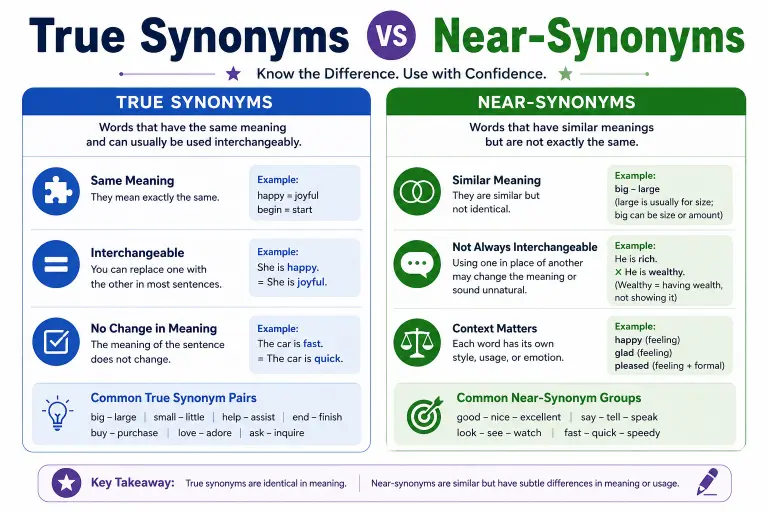
The most important point is that “around” does not have one universal synonym. Its meaning changes according to the sentence.
| Type | What It Means | Can It Replace “Around”? |
|---|---|---|
| True synonym | Has nearly the same meaning in the same context | Often |
| Near synonym | Similar meaning but slightly different nuance | Sometimes |
| Contextual alternative | Works only for one particular meaning | Only in that context |
| Broader expression | Covers a wider idea than “around” in that sentence | Sometimes |
| Narrower expression | Gives a more specific meaning | Only when that meaning is intended |
For example:
- Around 50 people → approximately 50 people
- Around the building → near the building or surrounding the building, depending on meaning
- Walk around the park → walk throughout the park if you mean across the park
- Look around → look about in some contexts
- Around noon → approximately noon or about noon
The replacement must match the specific sense of the original word.
Industry-Specific Usage
Business Writing
Business writing usually benefits from precise alternatives.
Instead of:
The project should take around three months.
You can write:
The project should take approximately three months.
For location:
The company operates in the surrounding area.
For distribution:
Our services are available throughout the region.
Choose the wording based on whether you mean an estimate, location, or distribution.
Corporate Communication
Reports and internal announcements often use “approximately,” “throughout,” “near,” and “surrounding” because these words make the intended meaning clearer.
Example:
The training program will reach approximately 500 employees across three offices.
Here, “approximately” describes the number, while “across” describes distribution.
Academic Writing
Academic writing should favor precision.
Instead of:
Around 40 percent of participants responded.
You may use:
Approximately 40 percent of participants responded.
However, “approximately” should not be used if the exact number is known and relevant.
Example:
The study included 42 participants.
If 42 is the exact figure, there is usually no reason to write “approximately 42.”
Customer Service
Customer service language should be clear and friendly.
Instead of:
There is a store around the corner.
You could write:
There is a store nearby.
Or:
You can find another branch close by.
“Nearby” is often more direct and natural than a formal phrase such as “in the vicinity.”
Legal Writing
Legal writing requires particular care because words describing location, quantity, scope, or time can have specific meanings.
For example, replacing “around” with “approximately” may be reasonable when discussing an estimate, but replacing it with “nearly” changes the implication.
- Approximately 100 units allows a range around 100.
- Nearly 100 units normally suggests a number just below 100.
Legal documents should therefore use the wording that accurately reflects the intended scope rather than choosing a synonym simply for variety.
Email Communication
Professional emails benefit from natural precision.
Client Email
Subject: Project Timeline Update
Hello Sarah,
The revised project is expected to take approximately three weeks to complete. I’ll send another update once the final testing schedule is confirmed.
Best,
James
Internal Workplace Email
Subject: Meeting Time
Hi Team,
Let’s meet at around 2:00 p.m. tomorrow to review the latest changes. I’ll send the meeting link shortly.
Thanks,
Maya
Here, “around” is perfectly acceptable because the exact minute is not important.
Vendor Communication
Subject: Delivery Estimate
Hello,
Could you please confirm whether the shipment is expected near the end of the month? We are arranging storage accordingly.
Thank you,
Daniel
Academic Communication
Subject: Assignment Submission
Dear Professor Lee,
I expect to submit the revised assignment by approximately 5:00 p.m. today. Please let me know if there are any additional requirements.
Kind regards,
Emily
Customer Service
Subject: Store Location
Hello,
There is another branch nearby, approximately five minutes from the main shopping center. I hope this helps.
Best regards,
Customer Support
Short Dialogue Examples
Workplace
Person A: When should we expect the report?
Person B: It should be ready at around 4 p.m.
Classroom
Person A: How many students joined the workshop?
Person B: Approximately 25 attended.
Customer Service
Person A: Is there a restaurant near here?
Person B: Yes. There’s one nearby, just across the street.
Casual Conversation
Person A: Where were you?
Person B: I was just walking around the neighborhood.
Professional Discussion
Person A: Where are most of your customers located?
Person B: They’re spread across the region.
How to Replace “Around” in a Sentence
1. Approximate number
Original:
There were around 60 guests.
Alternative:
There were approximately 60 guests.
Why it works:
“Approximately” preserves the estimated-number meaning while sounding more formal.
2. Approximate time
Original:
The train arrives around noon.
Alternative:
The train arrives at about noon.
Why it works:
“About” is a natural alternative when referring to an approximate time.
3. Nearby location
Original:
There is a bank around the corner.
Alternative:
There is a bank nearby.
Why it works:
“Nearby” communicates general proximity but removes the specific implication of being around a corner.
4. Surrounding area
Original:
The houses around the lake are expensive.
Alternative:
The houses surrounding the lake are expensive.
Why it works:
“Surrounding” makes the physical relationship more explicit.
5. Distribution
Original:
The company has offices around the country.
Alternative:
The company has offices throughout the country.
Why it works:
“Throughout” emphasizes distribution across the entire country.
6. Approximate cost
Original:
The repairs will cost around $500.
Alternative:
The repairs will cost roughly $500.
Why it works:
“Roughly” preserves the approximate nature of the estimate while remaining conversational.
7. Approximate percentage
Original:
Around 70% of customers preferred the first option.
Alternative:
Approximately 70% of customers preferred the first option.
Why it works:
The formal alternative is suitable for reports and research writing.
8. Nearby location
Original:
Several shops are around the hotel.
Alternative:
Several shops are located near the hotel.
Why it works:
“Near” clearly communicates proximity without suggesting that the shops completely surround the hotel.
9. Movement across an area
Original:
We walked around the city.
Alternative:
We walked throughout the city.
Why it works:
“Throughout” works when the intended meaning is movement or activity across many parts of the city. It may not be appropriate if the speaker simply means walking without a particular destination.
10. Scattered locations
Original:
There were signs around the building.
Alternative:
There were signs in various places around the building.
Why it works:
The alternative gives more information about distribution instead of simply replacing one word.
Comparison Table
| Phrase | Tone | Meaning / Scope | Best Use | Example |
|---|---|---|---|---|
| Around | Neutral | Approximate, nearby, surrounding, or movement | General use | Around 50 people came. |
| Approximately | Formal | Estimated amount or time | Reports and academic writing | Approximately 50 people came. |
| About | Neutral | Approximate amount or time | Everyday communication | About 50 people came. |
| Roughly | Neutral | Approximate amount | Estimates | Roughly 50 people came. |
| Nearly | Neutral | Almost reaching a number | Specific estimates | Nearly 50 people came. |
| Near | Neutral | Close to a location | Directions | The hotel is near the station. |
| Nearby | Casual-neutral | In a close location | Everyday speech | A store is nearby. |
| Surrounding | Formal-neutral | Located around something | Physical descriptions | The surrounding buildings are old. |
| Encircling | Formal | Forming a circle around | Precise descriptions | A wall encircles the garden. |
| Enclosing | Formal | Containing or surrounding | Technical descriptions | A fence encloses the property. |
| Throughout | Formal-neutral | Across an entire area | Reports and general writing | Stores operate throughout the city. |
| Across | Neutral | Distributed over an area | Business and geography | Offices exist across the country. |
| Close to | Neutral | Near or approximately | Location and estimates | The price is close to $100. |
| Close by | Casual | Very near | Conversation | The station is close by. |
| Here and there | Informal | In scattered locations | Casual descriptions | Books were lying here and there. |
Which Alternative Should You Choose?
For formal writing
Use approximately, throughout, in the vicinity of, or surrounding, depending on the meaning.
For business communication
Use approximately for numbers and near, throughout, or across for locations and distribution.
For academic writing
Prefer approximately when estimating numbers and throughout or across when describing distribution.
For legal writing
Choose the most precise expression. Do not substitute words merely to avoid repetition.
For professional email
Use approximately, about, near, or nearby, depending on the context. Natural wording is usually better than unnecessarily formal wording.
For everyday conversation
Around, about, near, nearby, and roughly are usually comfortable choices.
For casual messages
About, around, nearby, and close by sound natural.
Grammar and Usage Guide
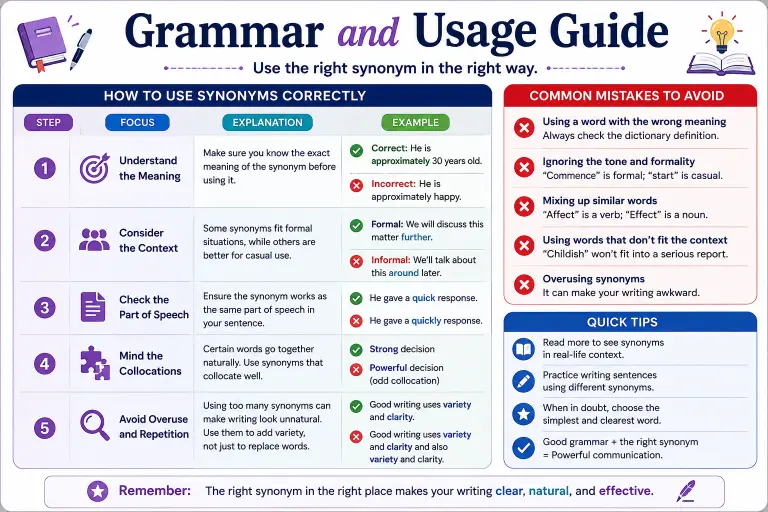
1. “Around” before a number
When “around” means approximately, it normally comes directly before the number.
Correct:
There were around 100 visitors.
Also correct:
There were approximately 100 visitors.
2. “Around” with time
“Around” can indicate an approximate time.
Example:
I’ll call you around 7 p.m.
This does not mean exactly 7 p.m. It indicates a time close to 7.
3. “Around” as a preposition
“Around” can describe location.
Example:
They walked around the building.
Here, it can describe movement surrounding or alongside the building.
4. “Around” as an adverb
It can also describe movement or presence without a direct object.
Example:
Is John around?
Here, “around” means available or present nearby. Replacing it with “approximately” would completely change the meaning.
5. “Around” and “about”
When both mean approximately, they are often interchangeable.
Around 20 students attended.
About 20 students attended.
Both are natural.
6. “Around” and “nearly” are not identical
Around 100 people attended.
The number could be somewhat below or above 100.
Nearly 100 people attended.
The number is expected to be below 100 and close to it.
7. “Around” and “throughout” are different
We traveled around the country.
This can describe traveling from one place to another within the country.
We traveled throughout the country.
This more strongly suggests traveling across many or most parts of the country.
8. “Around” and “surrounding” are not always interchangeable
The trees around the house are tall.
This is natural.
The surrounding trees are tall.
This also works, but “surrounding” makes the relationship between the trees and house more explicit.
Common Mistakes to Avoid
1. Treating every alternative as an exact synonym
“Approximately,” “near,” and “surrounding” do not have the same meaning. Identify the sense of “around” before replacing it.
2. Using “nearly” for any estimate
“Nearly” normally suggests being just below a particular number.
3. Using formal wording unnecessarily
“In the vicinity of” can sound awkward when “near” communicates the idea more clearly.
4. Replacing “around” when it is already the best word
Sometimes the simplest word is the strongest choice. “The meeting starts around noon” sounds completely natural.
5. Using “throughout” when only a few locations are meant
“Throughout the city” can suggest broad distribution. It is not always equivalent to “around the city.”
6. Confusing physical location with approximation
“The store is around the station” and “the event has around 100 guests” use “around” in completely different ways.
7. Making an estimate sound exact
Changing “around 50” to “50” removes the uncertainty.
8. Using casual wording in formal documents
“Here and there” may be natural in conversation but can sound vague in a technical report.
When Not to Use “Around”
There are times when another word gives readers more useful information.
When an exact number is known
Instead of:
Around 47 students attended.
If 47 is the confirmed number and precision matters, write:
47 students attended.
When a formal estimate is needed
For a report, “approximately” may be clearer than “around.”
When location needs to be precise
If you know the exact location, say:
The office is beside the library.
rather than:
The office is around the library.
When “around” could create ambiguity
If the reader might not know whether you mean approximately, nearby, or surrounding, use a more specific word.
When distribution is the main idea
Use throughout or across when you want to emphasize broad distribution.
When the audience needs technical precision
Technical and scientific documents should use the most accurate terminology available.
When the original phrase is actually better
Do not avoid “around” just because you want vocabulary variety. In everyday English, it is concise, familiar, and perfectly correct.
Advanced Writer Tips
Tone Control
Choose words based on formality:
- Casual: about, around, close by
- Neutral: near, roughly, close to
- Formal: approximately, throughout, in the vicinity of
The most formal word is not automatically the best word.
Professional Email Etiquette
Professional emails should be clear rather than complicated.
Natural:
The meeting will start at around 3 p.m.
More formal:
The meeting will begin at approximately 3 p.m.
Both are acceptable. Choose according to the tone of the organization and message.
Politeness
Word choice can affect how direct a message feels.
Compare:
Send me the report around noon.
with:
Could you please send me the report by around noon?
The second version is more polite because the sentence structure—not simply the synonym—softens the request.
Context Alignment
Ask yourself what “around” means before choosing a replacement:
Approximation? → roughly
Location? → nearby, close to
Precision
Do not choose a synonym merely because it sounds sophisticated. Choose the word that communicates the exact relationship you mean.
Readability
If a short word works, use it.
The hotel is near the airport.
is usually better than:
The hotel is situated in the vicinity of the airport.
The second sentence is not necessarily wrong, but it adds formality without adding much information.
FAQs
What is the closest synonym for “around”?
There is no single closest synonym for every use of “around.” About is often the closest alternative when “around” means approximately. Near is closer when it refers to location, while surrounding is appropriate when it means positioned on all sides.
What is a formal word for “around”?
Approximately is the most useful formal alternative when “around” refers to an estimated number, amount, or time. For location, formal choices include in the vicinity of and surrounding, depending on the intended meaning.
Is “about” more formal than “around”?
Neither is significantly more formal in ordinary use. Both are natural and neutral when they mean approximately. Approximately is more formal and precise.
Is “approximately” exactly the same as “around”?
When both refer to an estimate, they are often interchangeable. However, “approximately” has a more formal tone and is common in reports, academic writing, and technical documents.
What can I say instead of “around” in an essay?
estimates, use approximately or roughly. broad distribution, consider throughout or across. For physical surroundings, surrounding may be appropriate. Always choose according to the sentence’s meaning.
Is “roughly” a good replacement for “around”?
Yes, when both describe an approximate number, amount, distance, or time. “Roughly” is usually a little more conversational than “approximately.”
Is “nearby” the same as “around”?
Not always. “Nearby” specifically means in a close location. “Around” can mean nearby, but it can also mean approximately, surrounding, or moving in different places.
Key Takeaways
- Around has several meanings, so its best synonym depends on context.
- Use approximately, about, or roughly for estimates.
- Use near, nearby, or close to for physical proximity.
- Use surrounding, encircling, or enclosing when describing something positioned around another object.
- Do not replace “around” automatically; sometimes it is the clearest and most natural choice.
Conclusion:
The best to w choose synonyms for around is to identify what the word means in the specific sentence.If it expresses an estimate, approximately, about, roughly, and close to are useful choices.
If it describes location, near, nearby, and in the vicinity of may work better.
When it describes something positioned on all sides, surrounding, encircling, or enclosing can provide greater precision. For broad distribution, throughout and across are often stronger options.
Context should always come before vocabulary variety. A formal alternative is not automatically a better alternative, and two words that look similar can carry different meanings.
In everyday English, “around” is often perfectly natural. In professional, academic, or technical writing, however, a more specific word can make your meaning clearer.Choose the alternative that matches your intended meaning, audience, tone, and level of precision.
