
The word missing can describe several different situations: a person who cannot be found, an object that has disappeared, information that was left out, something that is absent, or a person who failed to attend. Because its meaning changes with context, choosing the right alternative is more than simply swapping one word for another.
The best replacement depends on what you mean by missing. In a formal report, absent, unavailable, or omitted may be more precise. In everyday conversation, lost, gone, or not there may sound more natural. This guide explains the closest synonyms, formal and casual alternatives, industry-specific choices, grammar patterns, and practical examples so you can choose wording that matches your exact meaning.
Quick Answer
Common synonyms for missing include absent, unavailable, lost, gone, lacking, omitted, overlooked, misplaced, unavailable, unaccounted for, incomplete, deficient, and overdue. The correct alternative depends on whether something is lost, absent, excluded, unavailable, or not present when expected.
Quick List: Fast Reader Guide
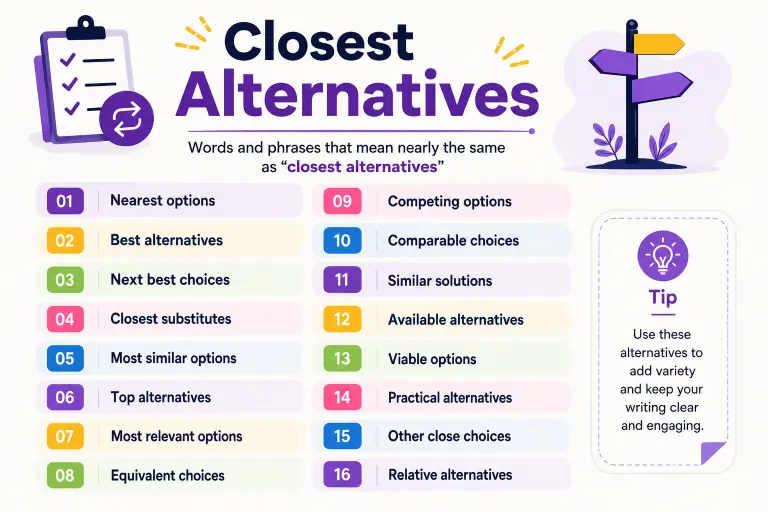
Closest alternatives
- Absent
- Lost
- Unavailable
- Lacking
- Omitted
- Overlooked
- Misplaced
- Unaccounted for
- Not present
Formal alternatives
- Absent
- Unavailable
- Omitted
- Unaccounted for
- Outstanding
- Incomplete
- Deficient
- Not received
- Not available
- Unreported
Neutral alternatives
- Not there
- Not included
- Left out
- Not found
- Not present
- Missing from
- Not available
- Not received
Casual alternatives
- Gone
- Lost
- Left out
- Nowhere to be found
- Not around
- Not there
Context-specific alternatives
- A missing person: unaccounted for, whereabouts unknown
- A missing item: lost, misplaced, gone
- Missing information: omitted, absent, unavailable
- Missing a class: absent
- Missing a deadline: overdue, late
- Missing a requirement: lacking, incomplete
- Missing a payment: overdue, unpaid
- Missing a section: omitted, left out
Formal Alternatives to “Missing”
1. Absent
Meaning:
Not present in a particular place or situation.
Explanation:
Absent is one of the closest formal alternatives to missing when something or someone is not present. It does not necessarily mean the person or object has disappeared.
Example:
“Several students were absent from the afternoon session.”
Best Use:
Academic writing, workplace reports, attendance records, and formal communication.
Worst Use:
Avoid absent when you specifically mean something has been lost or cannot be located.
Tone:
Formal and neutral.
2. Unavailable
Meaning:
Not accessible, obtainable, or ready for use.
Explanation:
Unavailable is useful when something exists but cannot currently be accessed. It does not necessarily mean it is lost.
Example:
“The requested document is currently unavailable.”
Best Use:
Business communication, websites, customer service, and professional emails.
Worst Use:
Do not use it for a person who has disappeared if you mean their location is unknown.
Tone:
Professional and neutral.
3. Omitted
Meaning:
Left out intentionally or unintentionally.
Explanation:
Omitted is more precise than missing when information, text, or an item should have been included but was not.
Example:
“The final paragraph was accidentally omitted from the report.”
Best Use:
Academic writing, editing, reports, instructions, and documentation.
Worst Use:
It is inappropriate if an object has simply been lost.
Tone:
Formal and precise.
4. Unaccounted For
Meaning:
Unable to be located, explained, or included in an expected total.
Explanation:
This phrase often suggests that something should be accounted for but currently cannot be identified or located.
Example:
“Two company devices remain unaccounted for.”
Best Use:
Business reports, investigations, inventory records, and formal documentation.
Worst Use:
It can sound unnecessarily formal in ordinary conversation.
Tone:
Formal and investigative.
5. Outstanding
Meaning:
Not yet completed, resolved, received, or dealt with.
Explanation:
Outstanding can replace missing in situations involving payments, documents, tasks, or responses. It changes the meaning slightly because it emphasizes something that remains unfinished or unresolved.
Example:
“Three invoices are still outstanding.”
Best Use:
Finance, business communication, administration, and professional emails.
Worst Use:
Do not use it simply to describe a physically lost object.
Tone:
Professional.
6. Incomplete
Meaning:
Not containing everything that should be included.
Explanation:
Use incomplete when something lacks one or more required parts.
Example:
“The application is incomplete because the signature is missing.”
Best Use:
Forms, assignments, reports, applications, and technical documents.
Worst Use:
It does not mean that the entire object has disappeared.
Tone:
Neutral to formal.
7. Deficient
Meaning:
Lacking something necessary or required.
Explanation:
Deficient focuses on a shortage or weakness rather than simple absence.
Example:
“The proposal is deficient in supporting evidence.”
Best Use:
Academic, technical, professional, and analytical writing.
Worst Use:
It may sound too severe for a simple omission.
Tone:
Formal and analytical.
8. Not Received
Meaning:
Something expected has not arrived or been delivered.
Explanation:
This is more precise than missing for emails, payments, packages, documents, or submissions.
Example:
“We have not received the signed agreement.”
Best Use:
Business emails, customer service, shipping, and administration.
Worst Use:
Avoid it when you know the item was received but later lost.
Tone:
Professional and clear.
9. Not Available
Meaning:
Something cannot currently be accessed or obtained.
Explanation:
This is a straightforward formal alternative when the issue is access rather than disappearance.
Example:
“The archived records are not available at this time.”
Best Use:
Websites, databases, reports, customer service, and professional communication.
Worst Use:
It can be vague if the real issue is that something was accidentally deleted or lost.
Tone:
Neutral and professional.
10. Unreported
Meaning:
Not recorded, documented, or reported.
Explanation:
Unreported applies when information has not been formally communicated.
Example:
“Several incidents may remain unreported.”
Best Use:
Reports, research, journalism, administration, and formal analysis.
Worst Use:
Do not use it for a missing physical object.
Tone:
Formal.
Semi-Formal and Neutral Alternatives
11. Lost
Meaning:
Unable to be found or no longer in someone’s possession.
Explanation:
Lost is one of the most common alternatives to missing for physical objects. It usually suggests that the location is unknown.
Example:
“I think I lost my keys.”
Best Use:
Everyday conversation, emails, and simple explanations.
Worst Use:
It can be inaccurate if you know exactly where the object is but simply cannot access it.
Tone:
Neutral and conversational.
12. Misplaced
Meaning:
Put somewhere unintentionally and then unable to be found.
Explanation:
Misplaced is narrower than lost. It often suggests that the item is probably still nearby.
Example:
“I may have misplaced the receipt.”
Best Use:
Workplaces, homes, offices, and polite explanations.
Worst Use:
Avoid it if an item has definitely been stolen or permanently lost.
Tone:
Polite and neutral.
13. Gone
Meaning:
No longer present.
Explanation:
Gone is very flexible, but it does not explain why something is absent.
Example:
“The files are gone from the shared folder.”
Best Use:
Everyday conversation and informal writing.
Worst Use:
It can be too vague for a formal report.
Tone:
Casual and direct.
14. Not Present
Meaning:
Not in the expected place or situation.
Explanation:
This is a direct and neutral alternative to missing when discussing attendance or physical presence.
Example:
“The manager was not present during the meeting.”
Best Use:
Work, school, reports, and neutral communication.
Worst Use:
It does not imply that someone has disappeared.
Tone:
Neutral.
15. Left Out
Meaning:
Not included.
Explanation:
Left out is usually used for information, people, items, or details that were excluded.
Example:
“The address was accidentally left out of the form.”
Best Use:
Everyday writing, editing, instructions, and informal explanations.
Worst Use:
It is not appropriate when something has simply been misplaced.
Tone:
Conversational.
16. Not Included
Meaning:
Excluded from something.
Explanation:
This is a clear alternative when an item or detail does not appear in a document, package, list, or plan.
Example:
“The warranty information was not included with the product.”
Best Use:
Websites, instructions, business writing, and customer service.
Worst Use:
It may imply intentional exclusion when the omission was accidental.
Tone:
Neutral and professional.
17. Not Found
Meaning:
Unable to be located after searching.
Explanation:
Not found focuses on the result of a search rather than why something is absent.
Example:
“The requested record was not found in the database.”
Best Use:
Technical writing, websites, databases, customer service, and everyday communication.
Worst Use:
Avoid using it to imply that something was permanently lost.
Tone:
Neutral.
18. Lacking
Meaning:
Not having enough of something necessary or desirable.
Explanation:
Lacking is different from physical absence. It usually describes a quality, feature, resource, or requirement.
Example:
“The essay is strong but lacking a clear conclusion.”
Best Use:
Academic, professional, and analytical writing.
Worst Use:
It sounds strange for a person who simply failed to attend.
Tone:
Neutral to formal.
19. Overlooked
Meaning:
Failed to notice, consider, or include something.
Explanation:
Overlooked suggests that something was missed because someone did not notice it.
Example:
“We overlooked one important detail in the original proposal.”
Best Use:
Professional communication, editing, project discussions, and academic writing.
Worst Use:
It does not mean an object has physically disappeared.
Tone:
Neutral and professional.
20. Unavailable
Meaning:
Not accessible or obtainable at the moment.
Explanation:
This works especially well for services, information, people, appointments, and resources.
Example:
“The specialist is unavailable this afternoon.”
Best Use:
Professional communication and customer service.
Worst Use:
It is not a good replacement when you need to communicate that someone’s whereabouts are unknown.
Tone:
Professional and neutral.
Informal and Casual Alternatives
21. Not There
Meaning:
Not in the expected place.
Example:
“I went back for my jacket, but it wasn’t there.”
When it sounds natural:
Everyday conversation.
When to avoid it:
Formal reports or academic writing.
Tone:
Very natural and conversational.
22. Nowhere to Be Found
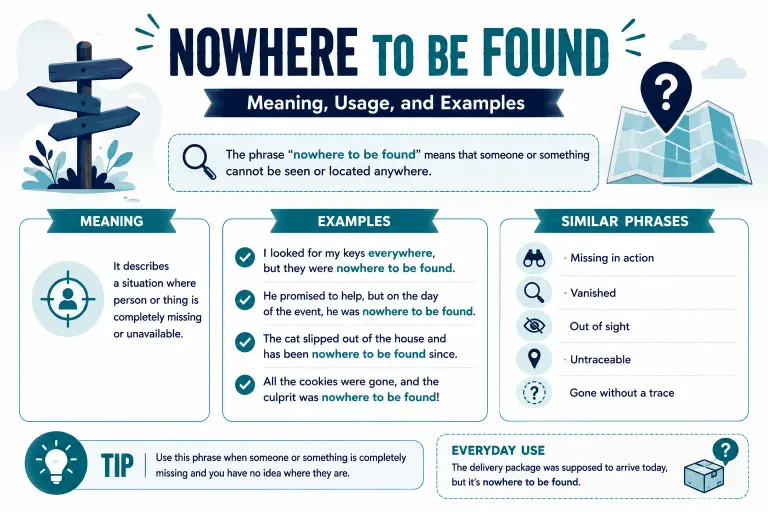
Meaning:
Unable to be located despite looking for something.
Example:
“My phone was nowhere to be found.”
When it sounds natural:
Stories and casual conversation.
When to avoid it:
Formal business documentation.
Tone:
Conversational and expressive.
23. Not Around
Meaning:
Not present or available.
Example:
“Sam isn’t around right now.”
When it sounds natural:
Informal conversations.
When to avoid it:
Formal workplace or academic writing.
Tone:
Casual.
24. Gone Missing
Meaning:
Has disappeared and cannot currently be located.
Example:
“One of the documents has gone missing.”
When it sounds natural:
News-style writing, conversation, and everyday descriptions.
When to avoid it:
Highly technical documentation where a more precise explanation is available.
Tone:
Neutral to conversational.
25. Lost Track Of
Meaning:
No longer knowing where someone or something is or what happened to it.
Example:
“I’ve lost track of the original version of the file.”
When it sounds natural:
Casual conversation and informal workplace communication.
When to avoid it:
Legal or highly formal records.
Tone:
Casual.
True Synonyms vs. Contextual Alternatives
Not every replacement for missing has the same meaning. This distinction matters because missing can describe absence, loss, omission, or failure to arrive.
| Type | What It Means | Can It Replace “Missing”? |
|---|---|---|
| True/very close synonym | Not present or unable to be found | Often |
| Near synonym | Similar idea but with a slightly different focus | Sometimes |
| Contextual alternative | Works in a particular situation | Only in that context |
| Broader expression | Describes absence without explaining why | Sometimes |
| Narrower expression | Describes a specific kind of absence | Only for that situation |
For example, lost is suitable for a missing wallet, but not necessarily for a missing paragraph. Omitted works for a missing paragraph but would be inappropriate for a lost wallet. Absent works well for a student who is not in class, while unaccounted for suggests a more serious inability to explain someone’s location or an item’s status.
The safest approach is to identify why something is missing before choosing a replacement.
Industry-Specific Usage
Business Writing
Business writing usually benefits from precise alternatives rather than vague wording.
Instead of:
“The information is missing.”
Consider:
- “The information was omitted.”
- “The required information was not provided.”
- “The document is incomplete.”
- “The requested details are unavailable.”
- “The supporting information has not been received.”
Example:
“The application is incomplete because the tax identification number was not provided.”
That sentence is more useful than simply saying something is missing.
Corporate Communication
Corporate documents often need language that distinguishes between absence, delay, omission, and lack of access.
For example:
“Two attachments were omitted from the original email.”
is more precise than:
“Two attachments are missing.”
For an unresolved item:
“The supporting documentation remains outstanding.”
For a person who has not attended:
“Three team members were absent from the briefing.”
The best corporate language explains the specific problem instead of relying on missing for every situation.
Academic Writing
Academic writing often benefits from words such as absent, lacking, omitted, incomplete, insufficient, and overlooked.
Examples:
- “The study lacks sufficient supporting evidence.”
- “One important variable was omitted from the analysis.”
- “The argument is incomplete without historical context.”
- “The paper lacks a clear explanation of the methodology.”
Be careful with deficient, which can sound strongly critical.
Customer Service
Customer service language should be clear without sounding accusatory.
Instead of:
“Your information is missing.”
Try:
“We still need your billing address to complete the order.”
Or:
“We have not yet received the document required to process your request.”
This approach tells the customer exactly what needs attention.
Legal Writing
Legal writing requires extra precision because missing, absent, omitted, not received, and unaccounted for can describe different facts.
For example:
- Not received — indicates that something did not arrive.
- Omitted — indicates that something was left out.
- Unavailable — indicates that something cannot currently be accessed.
- Unaccounted for — indicates that its status or location cannot be established.
A casual substitute such as gone may be too vague for a legal document. The exact wording should reflect the facts being documented.
Email Communication
Professional emails benefit from replacing missing with a phrase that explains the actual issue.
client for a
“We have not yet received the signed agreement.”
For an internal request
“The final page appears to be missing from the document.”
customer for a
“The order arrived without the installation guide.”
For a colleague
“One attachment was omitted from the original email.”
For a follow-up
“The payment remains outstanding.”
These choices sound more professional because they identify the problem rather than simply labeling it missing.
Email Examples
1. Client Communication
Subject: Signed Agreement Not Yet Received
Hello Jordan,
Thank you for reviewing the agreement. We have received the completed form, but we have not yet received the signed copy.
Could you please send the signed document when convenient? Once we receive it, we can move forward with the next step.
Best,
Maya
2. Project Update
Subject: Updated Project File
Hi Team,
The previous version of the project file was incomplete because the final budget section was omitted.
I’ve attached the corrected version, which now includes the budget details and supporting notes.
Thanks,
Daniel
3. Request for Information
Subject: Additional Information Needed
Hello Priya,
Thank you for submitting your application. We noticed that the emergency contact information was not included.
Please send the missing details when you have a chance so we can complete the review.
Best regards,
Alex
4. Customer Service
Subject: Your Order Documentation
Hello Marcus,
We’re sorry that the installation guide was not included with your order.
We’ve arranged for a replacement copy to be sent to you. You should receive it shortly.
Thank you for your patience,
Customer Support
5. Vendor Communication
Subject: Outstanding Invoice
Hello Taylor,
Our records show that invoice 1047 remains outstanding. If payment has already been sent, please disregard this message and let us know so we can update our records.
Thank you,
Nina
6. Academic Communication
Subject: Assignment Submission
Dear Professor Lee,
I reviewed my submitted assignment and noticed that the reference list was accidentally omitted from the uploaded document.
I’ve attached the corrected version for your review.
Thank you,
Chris
Short Dialogue Examples
1. Workplace
Person A: Is the sales report complete?
Person B: Almost. The regional figures are missing.
Person A: I’ll add them before we send it.
2. Classroom
A: Why did I lose points on this assignment?
Person B: Your conclusion is missing.
see. I’ll add one before submitting the revision.
3. Customer Service
Person A: My package arrived, but the instructions weren’t included.
Person B: I’m sorry about that. We’ll send you a replacement copy.
4. Casual Conversation
A :person Have you seen my headphones?
Person B: No. They’re nowhere to be found?
Person A: I think I may have misplaced them.
5. Professional Discussion
Person A: Why isn’t the report ready yet?
We’re still waiting for two pieces of information.
So the report is incomplete?
Person B: Exactly.
How to Replace “Missing” in a Sentence
Example 1
Original:
“The report is missing important information.”
Alternative:
“The report lacks important information.”
Why it works:
Lacks focuses on insufficiency rather than simple absence and sounds appropriate in analytical writing.
Example 2
Original:
“The document is missing a signature.”
Alternative:
“The document has not been signed.”
Why it works:
The alternative is more direct and clearly states what action has not occurred.
Example 3
Original:
“The file is missing from the folder.”
Alternative:
“The file is not present in the folder.”
Why it works:
This sounds neutral and avoids suggesting that the file has been permanently lost.
Example 4
Original:
“She is missing from class.”
Alternative:
“She is absent from class.”
Why it works:
Absent is the standard choice for attendance situations.
Example 5
Original:
“The paragraph is missing from the article.”
Alternative:
“The paragraph was omitted from the article.”
Why it works:
Omitted specifically describes something that was left out.
Example 6
Original:
“My wallet is missing.”
Alternative:
“I can’t find my wallet.”
Why it works:
This sounds more natural in everyday conversation and avoids implying a specific cause.
Example 7
Original:
“The payment is missing.”
Alternative:
“The payment has not been received.”
Why it works:
The alternative is much more precise in financial communication.
Example 8
Original:
“Two employees are missing from the meeting.”
Alternative:
“Two employees are absent from the meeting.”
Why it works:
Absent is more appropriate when the issue is simply non-attendance.
Comparison Table
| Phrase | Tone | Meaning / Scope | Best Use | Example |
|---|---|---|---|---|
| Missing | Neutral | Not present, found, or included | General use | “A page is missing.” |
| Absent | Formal/neutral | Not present | School, work | “She was absent.” |
| Lost | Neutral | Cannot be found | Objects | “My keys are lost.” |
| Misplaced | Polite/neutral | Put somewhere unintentionally | Objects | “I misplaced the receipt.” |
| Omitted | Formal | Left out | Documents | “The section was omitted.” |
| Unavailable | Professional | Cannot be accessed | Services/info | “The file is unavailable.” |
| Lacking | Formal/neutral | Does not have enough | Qualities/resources | “The report is lacking detail.” |
| Incomplete | Neutral/formal | Missing required parts | Forms/work | “The application is incomplete.” |
| Left out | Casual | Not included | Everyday writing | “Her name was left out.” |
| Not found | Neutral | Could not be located | Searches/databases | “The record was not found.” |
| Unaccounted for | Formal | Status/location unknown | Reports/inventory | “Two items remain unaccounted for.” |
| Outstanding | Professional | Not completed or received | Payments/tasks | “The invoice is outstanding.” |
Which Alternative Should You Choose?
For formal writing
Choose absent, omitted, incomplete, deficient, unavailable, or unaccounted for, depending on the meaning.
For business communication
Use not received, outstanding, incomplete, omitted, or unavailable. These choices usually explain the problem more clearly.
For academic writing
Prefer absent, omitted, lacking, incomplete, or insufficient when they accurately describe the issue.
For legal writing
Choose the most fact-specific expression. Not received, omitted, and unaccounted for can communicate different factual situations.
For professional email
Use direct phrases such as not yet received, not included, omitted, or still outstanding.
For everyday conversation
Lost, gone, not there, misplaced, and can’t find are natural choices.
For casual messages
Use gone, lost, not there, or nowhere to be found, depending on the situation.
Grammar and Usage Guide
“Missing” as an Adjective
Missing commonly functions as an adjective:
“The missing document was eventually found.”
It can describe a person, object, part, detail, or piece of information.
“Missing” in the Present Progressive
Missing is also the present participle of miss:
“I am missing the meeting.”
This creates an important distinction.
Missing can mean absent or not present:
“Two pages are missing.”
But missing can also come from the verb miss:
“I am missing the bus.”
And:
“I miss my friends.”
These meanings should not be confused.
“Missing From”
Use missing from when identifying where something should be but is not:
“One page is missing from the report.”
“Several names are missing from the list.”
This structure is extremely common.
“Missing In”
Use missing in when referring to something absent within a larger document, collection, or situation:
“A key detail is missing in the final paragraph.”
However, missing from is often more natural when you are identifying the source or location:
“A key detail is missing from the final paragraph.”
“Missing” vs. “Missed”
These words have different functions.
Missing: absent, unavailable, lost, or not present.
“The document is missing.”
Missed: failed to attend, notice, catch, or experience something.
“I missed the meeting.”
You would not normally say:
“I missing the meeting.”
Instead:
“I missed the meeting.”
“Missing” vs. “Miss”
Compare:
“My phone is missing.”
This means you cannot find your phone.
“I miss my phone.”
This means you feel its absence or wish you had it.
The words are related but do not mean the same thing.
Plural Forms
Missing itself does not change for singular or plural nouns:
“One document is missing.”
“Three documents are missing.”
The noun determines singular or plural agreement.
Capitalization
Missing is normally lowercase unless it begins a sentence or appears in a title:
“The missing file was found.”
“Missing Information in Student Records”
Common Mistakes to Avoid
1. Treating Every Alternative as an Exact Synonym
Lost, omitted, absent, and unavailable are not interchangeable in every sentence. Choose based on the specific situation.
2. Using “Lost” for Information
Information can be lost, but if it was intentionally or accidentally excluded from a document, omitted may be more accurate.
3. Using “Absent” for Objects
You can describe an object as absent, but everyday English usually sounds more natural with missing, gone, or not present.
4. Using “Outstanding” for a Lost Item
Outstanding generally describes something unfinished, unpaid, unresolved, or still expected. It does not normally mean physically lost.
5. Making Professional Emails Too Vague
Instead of:
“Something is missing.”
Say:
“We have not yet received the signed form.”
The second sentence gives the reader useful information.
6. Using Casual Language in Formal Reports
Phrases such as gone or nowhere to be found may sound too informal for technical or corporate documentation.
7. Confusing “Missing” With “Missed”
A person can be missing, but you miss a meeting, deadline, bus, or opportunity.
8. Ignoring the Reason for Absence
If you know that something was omitted, say omitted. If it was misplaced, say misplaced. Specific language is usually stronger than a generic label.
When Not to Use “Missing”
You do not always need to replace missing. In fact, missing is often the clearest choice.
Avoid or reconsider it in these situations:
1. When you know something was omitted
Use:
“The section was omitted.”
instead of:
“The section is missing.”
2. When an item was not received
Use:
“We have not received the invoice.”
rather than:
“The invoice is missing.”
3. When someone simply did not attend
Use:
“The employee was absent.”
rather than:
“The employee was missing.”
The latter may suggest that the person’s location is unknown.
4. When you mean insufficient content
Use:
“The report lacks sufficient evidence.”
instead of:
“The report is missing evidence.”
Both can work, but lacks may be more precise in formal analysis.
5. When something is inaccessible
Use:
“The file is unavailable.”
rather than suggesting that it has disappeared.
6. When a task has not been completed
Use:
“The task remains outstanding.”
rather than:
“The task is missing.”
When “Missing” Is Better
Keep missing when the exact reason is unknown:
“One of the files is missing.”
This is simple, accurate, and does not make an unsupported assumption about what happened.
Advanced Writer Tips
Tone Control
Use lost, gone, or not there for conversational writing. Choose absent, omitted, unavailable, or unaccounted for when a more formal tone is needed.
Compare:
“The file is gone.”
with:
“The file is unavailable.”
The second sounds more professional but also gives less information about what happened.
Professional Email Etiquette
Avoid blaming the reader.
Instead of:
“You are missing the required document.”
Try:
“We have not yet received the required document.”
This keeps the message factual and polite.
Politeness
Words can subtly affect how a message feels.
“You left out the attachment.”
sounds direct and potentially accusatory.
“It looks like the attachment may have been omitted.”
sounds softer and leaves room for an accidental error.
Context Alignment
Always ask what kind of absence you are describing:
- Person not attending → absent
- Object cannot be located → lost/misplaced
- Information excluded → omitted
- Resource cannot be accessed → unavailable
- Required feature not present → lacking
- Task not completed → outstanding
- Document lacks required parts → incomplete
This simple distinction can dramatically improve word choice.
Precision
Do not use a stronger word than the evidence supports.
If you cannot find a document, say:
“The document cannot currently be located.”
Do not automatically say:
“The document was lost.”
The second statement assumes what happened.
Readability
Shorter wording is often clearer:
“We have not received the document.”
is usually better than:
“The document appears to be missing from the materials that were expected to have been submitted.”
Clear writing tells readers what they need to know without unnecessary wording.
FAQs
What is the closest synonym for “missing”?
The closest general alternatives are absent, not present, unavailable, and lost, but none works in every context. Absent focuses on non-presence, lost usually refers to something that cannot be found, and unavailable means something cannot currently be accessed.
What is a formal word for missing?
Absent, omitted, unavailable, incomplete, deficient, and unaccounted for can all work in formal writing. The correct choice depends on whether you mean absence, exclusion, lack, or an unexplained status.
What is a synonym for a missing person?
Depending on the situation, you might use unaccounted for, whose whereabouts are unknown, or not located. These phrases are more precise than simply calling a person “absent” when their location is genuinely unknown.
What is a synonym for missing information?
Useful alternatives include omitted information, unavailable information, insufficient information, absent information, and missing details. In formal writing, insufficient information or omitted information may be more precise.
What is a synonym for a missing item?
Lost, misplaced, gone, unavailable, not found, and unaccounted for can work. Misplaced is especially useful when you believe the item exists but has been put somewhere unintentionally.
What is a synonym for missing a deadline?
Use late, overdue, failed to meet the deadline, or past due, depending on the situation. Here, missing comes from the verb miss, so missed is often the correct grammatical form.
Is “omitted” the same as “missing”?
Not exactly. Omitted specifically means something was left out. Missing is broader and does not tell the reader why something is absent.
Key Takeaways
- Missing is a broad word that can describe absence, loss, omission, or lack of availability.
- Use absent for someone or something that is not present, especially in school or workplace settings.
- Use lost or misplaced for physical objects that cannot be located.
- Use omitted, incomplete, or lacking when information or required content is absent.
- In professional writing, choose the most precise phrase rather than automatically replacing missing with a generic synonym.
Conclusion:
Choosing the right alternative to missing starts with identifying what kind of absence you mean.
If a person is not at an event, absent is usually the clearest choice. If an object cannot be found, lost or misplaced may work better. For information that was left out, omitted is more precise, while incomplete describes something that lacks required parts.
In business settings, not received, unavailable, and outstanding can communicate specific situations more effectively.
There is no single synonym that works everywhere. The strongest writing matches the word to the situation, audience, and tone.
When the reason for an absence is unknown, missing itself may actually be the safest and clearest choice.
When the cause or type of absence is known, a more specific alternative can make your sentence more accurate, professional, and easier to understand.
